Building the BUCCAL-PEP film: pullulan as a material for buccal peptide delivery
Delivering peptide-based medicines without injections is an ongoing challenge. One promising option is the buccal route, where drugs are absorbed through the inside of the cheek. However, only a small amount of these drugs typically enters the body this way, so improved delivery systems are needed.
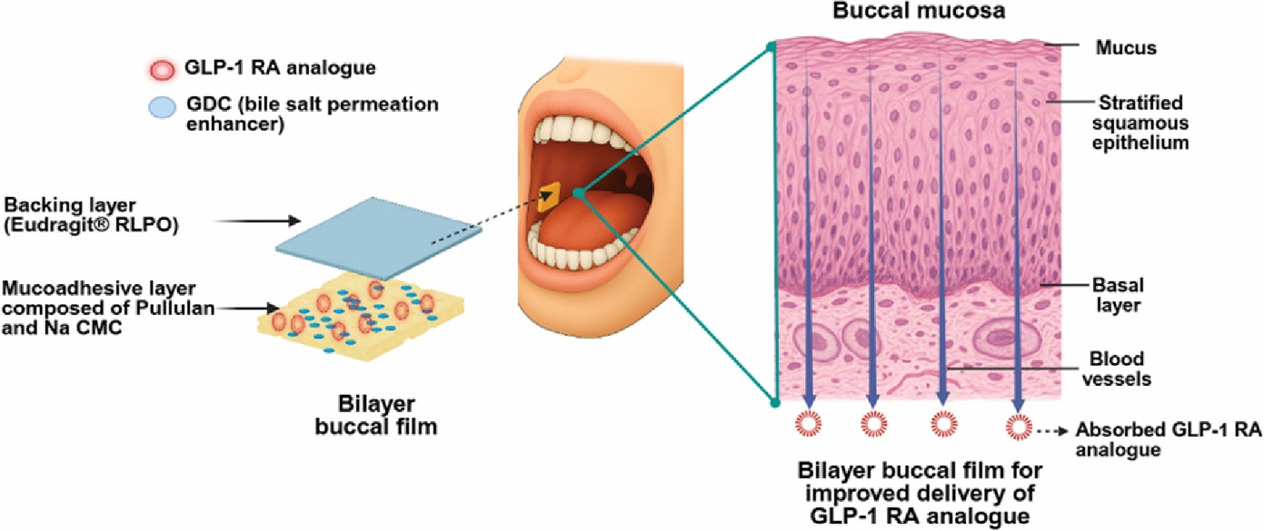
One of the central goals of the BUCCAL-PEP project is to develop exactly that – a film that sticks to the inside of the cheek, holds a peptide medicine in place, and releases it in a way that the body can absorb. In a recent publication, Sandeep Karki and the BUCCAL-PEP team at University College Dublin report a significant step in that direction: a prototype bilayer film made from pullulan, a natural water-soluble polymer.
Designing the BUCCAL-PEP film
In this study, the team explored the use of pullulan to create a thin film that can stick to the inside of the cheek and deliver drugs more effectively. They focused on a model drug similar to GLP-1 receptor agonists, which are commonly used to treat conditions like diabetes.
To help the drug pass through the cheek lining, the team combined it with a permeation enhancer — a substance that helps drugs cross biological barriers – called sodium glycodeoxycholate (GDC). They designed a two-layer (bilayer) film:
- a sticky inner layer (made from pullulan and another polymer)
- a protective outer layer that controls how the drug is released
The day-to-day work behind the film involved preparing and testing many different formulations, adjusting the materials and how they were processed, and continuously checking how the films performed from how well they stuck to tissue, to how quickly they dissolved, to whether they held their shape during handling. Sandeep describes it as an iterative process of optimisation that brought together formulation science, imaging, and tissue experiments under one project.
Why pullulan?
Choosing the right material was central to making this work. Pullulan is a naturally derived carbohydrate already used safely in food and consumer products — including dissolvable breath strips. The team compared it against two other film-forming materials: HPMC (hydroxypropyl methylcellulose) and PVA (polyvinyl alcohol) – both well-established pharmaceutical film-forming polymers. They found that pullulan came out ahead on most counts: it stuck more strongly to cheek tissue, dissolved faster in simulated saliva, and produced smoother, more uniform films. It also gave the films the mechanical strength needed for consistent manufacturing. For Sandeep and the team, this combination of properties made it the right material to take forward – and the one around which the rest of the film design could be built.
What the team achieved
With the material and design in place, the team moved to testing. Experiments using pig cheek tissue – a common and well-accepted model for human tissue – helped identify the best ratio of drug to enhancer to maximise absorption. With the optimised formulation, a small but measurable amount of the drug was able to pass through the tissue within three hours, both in simple films and in the two-layer design. Importantly, this occurred without causing visible damage to the tissue.
For Sandeep, two results stood out. The first was that the peptide could cross the cheek barrier directly from inside a film – rather than from a simple liquid solution –which is genuinely difficult to achieve and an important proof of concept for the BUCCAL-PEP approach. The second was that this happened without harming the tissue. Getting a drug across a biological barrier while keeping that barrier intact is one of the central design challenges in this field, and the results here show it is achievable with the right combination of materials and concentrations.
Looking ahead
While the results are promising, there are of course limitations to address. The study used a model peptide — a simplified version of the active medicine designed for lab-scale research — rather than a fully active clinical compound, which means the findings cannot yet be directly translated into clinical dose predictions. How the film feels in the mouth is also something the team plans to address as the work moves forward.
Importantly, these findings have already informed the next phase of BUCCAL-PEP research, where the optimised film has been evaluated in further preclinical studies with encouraging results. Work is now focused on improving peptide absorption, understanding transport mechanisms in greater detail, and advancing the platform toward clinical use — all in service of the project’s core goal: a patient-friendly, needle-free alternative to injectable peptide therapies.
Curious to read the full publication? Check it out here:

Sandeep Karki
Sandeep is a PhD student at University College Dublin (UCD)
Graphical abstract of the paper