In buccal drug-delivery, the ingredients matter – but so does where they are placed. Different prototype architectures are studied in the BUCCAL-PEP project – from bilayer, to trilayer, to grid designs. Each architecture offers different possibilities for organising the components of a formulation. The BUCCAL-PEP team at the Technical University of Denmark (DTU) works on this trilayer approach.
In their recent publication, they investigated whether changing the architecture in those multilayer films could control how a GLP-1 receptor agonist – a peptide medicine that mimics a natural hormone involved in regulating blood sugar and appetite – and the absorption booster are released at the cheek surface. By comparing films in which the two components were either combined or separated into different layers, the team showed that film structure can be used to programme their release sequence. Separating the components produced a more sustained, sequential release and improved their transport across buccal tissue, making the arrangement of the layers itself an important part of the formulation design.
Designing the multilayer film
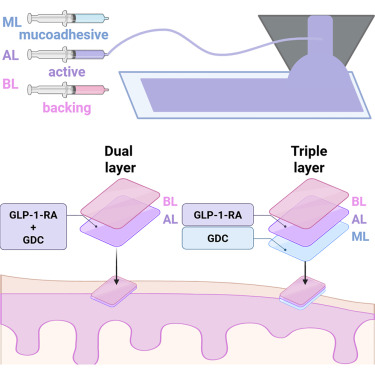
The trilayer concept started with a straightforward idea: instead of incorporating all active components into the same part of the film, researchers can give different components their own layers.
At the Technical University of Denmark (DTU), Eleftheria Pantazoglou and colleagues developed films containing a GLP-1 receptor agonist (GLP-1-RA) together with sodium glycodeoxycholate (GDC), a compound that helps the peptide cross the cheek barrier.
In the triple-layer designs, the two compounds occupied separate layers. This seemingly simple change gave the team a way to control the order and speed at which the ingredients became available.
To manufacture the films, the team used so-called slot-die coating. In this process, a thin layer is formed from a liquid formulation. After drying one layer, researchers can add another on top.
Why a multilayer design?
The absorption enhancer such as GDC can temporarily make the cheek barrier more permeable, helping small proteins move through it. But timing matters. Simply placing the peptide and enhancer together does not necessarily produce the most effective delivery.
A multilayer design could release the absorption booster first and sustain the release of the peptide therapeutic. The slot-die coating technique offers precise control over this architecture.
What the team achieved
The lab experiments showed that the trilayer films formed clearly defined layers, adhered well to buccal tissue and preserved the secondary structure of the GLP-1 receptor agonist. Most importantly for the design concept, the different layers influenced when the formulation components became available.
When the film encountered moisture, GDC was released first, while the GLP-1 receptor agonist followed with a more sustained release profile. This sequence reflects the way the two components had been positioned within the film and demonstrates that researchers could use the architecture itself to shape release over time.
The results provide a clearer picture of what can be achieved by separating formulation components into distinct layers. The trilayer approach could give the researchers another way to coordinate the interaction between a peptide, an absorption booster and the buccal surface – using not only what goes into the film, but also where each component is placed.
Curious to dive deeper into the results? Read the full publication here:

Eleftheria Pantazoglou
Eleftheria published this article during her PhD at the Technical University of Denmark (DTU).
Graphical abstract of the paper